When an enterprise server reaches end-of-life or your company upgrades its global fleet of laptops, what happens next? For many organizations, the answer is "out of sight, out of mind." Equipment is pushed into a storage closet, forgotten in a warehouse, or handed off to the lowest-bidding local recycler.
However, this passive approach carries massive hidden risks.
IT Asset Disposition (ITAD) is the formal, strategic process for retiring, disposing of, and recovering value from IT equipment. It is no longer just an operational task for the IT department; it is a critical business function that impacts legal, financial, and environmental bottom lines.
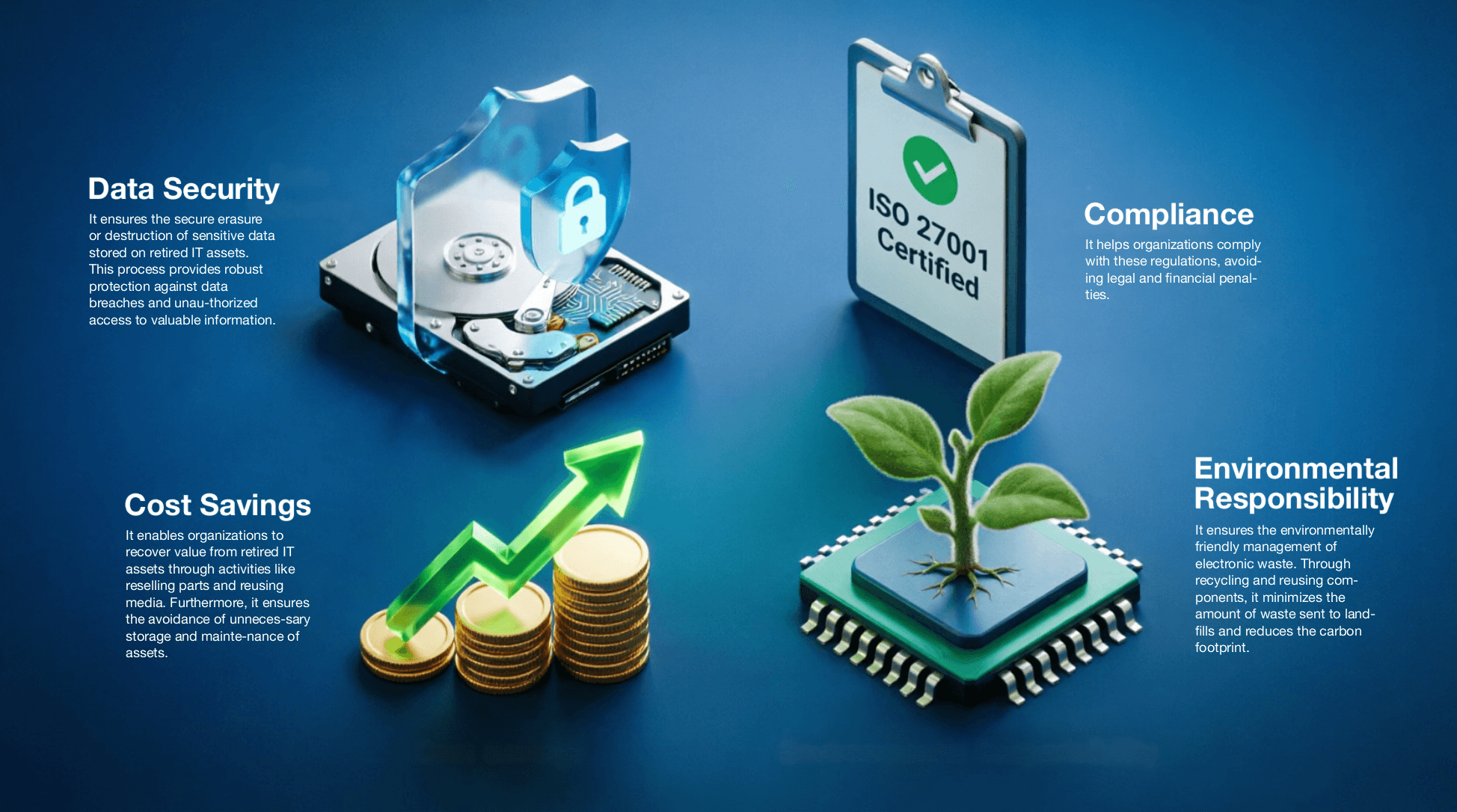
Here is why implementing a professional, certified ITAD program is non-negotiable, broken down into four essential pillars.
1. Data Security: Your Reputation Depends on It
The most urgent reason for proper ITAD is data security. A common misconception is that simply deleting files, reformatting a drive, or performing a factory reset erases data. In reality, these actions often only remove the "pointer" to the data, leaving the actual information intact and easily recoverable with basic, widely available software.
Inadequate data disposal leaves sensitive information—customer records, financial data, intellectual property, and employee PII—vulnerable to a devastating data breach.
A certified ITAD provider ensures complete data destruction through rigorous methods, such as NIST 800-88 compliant data wiping (which overwrites data multiple times) or physical destruction (industrial shredding). Furthermore, a professional provider maintains a strict, documented Chain of Custody from the moment the device leaves your premises to the moment it is destroyed. This provides a verifiable audit trail and a Certificate of Destruction, serving as your strongest line of defense in safeguarding your company's reputation.
2. Regulatory Compliance: Avoid Costly Penalties and Legal Liability
Businesses today are bound by a complex, ever-evolving web of data protection and privacy regulations, such as GDPR in Europe, CCPA in California, and PIPEDA in Canada. These laws mandate strict standards for how personal and sensitive data is handled, especially at end-of-life.
Non-compliance due to improper data disposal can result in massive financial penalties, severe legal liability, and public censure. Under many of these regulations, your organization remains legally responsible for the data on a device even after it has left your physical possession.
A structured ITAD process creates the necessary audit trail, documenting that every single device was processed according to legal requirements. By partnering with an ISO-certified ITAD provider, you turn a potential compliance liability into a demonstrable pillar of your corporate governance strategy, proving "due diligence" to regulators and auditors.
3. Cost Savings & Value Recovery: Turn Liabilities into Assets
Old IT equipment isn’t just e-waste—it often holds significant residual value. Professional ITAD partners assess retired assets to determine their highest and best use.
Devices with remaining lifecycle value are securely wiped, refurbished, and resold in the secondary market, directly recouping costs for your organization. Even devices that cannot be resold are harvested for valuable components or precious metals.
Beyond direct resale revenue, efficient ITAD streamlines logistics and reduces internal IT burden. It eliminates the hidden costs of storing, maintaining, and powering unused equipment in your data centers or offices. When you factor in the mitigation of costly data breach incidents, viewing ITAD as a strategic investment rather than a disposal expense reveals its true, substantial ROI.
4. Environmental Responsibility: Fulfill Your ESG Commitments
Electronic waste (e-waste) is the world’s fastest-growing waste stream. Dumping electronics in landfills not only wastes valuable resources but also poisons the environment with toxic heavy metals like lead, mercury, and cadmium.
A core tenet of modern ITAD is environmental stewardship and the promotion of a Circular Economy. Certified ITAD providers ensure ethical, downstream recycling, maximizing the recovery of precious metals, plastics, and rare earth materials while strictly minimizing landfill contribution.
For modern enterprises, this directly supports your corporate Environmental, Social, and Governance (ESG) goals. Proper ITAD helps reduce your organization's Scope 3 carbon emissions, provides accurate data for your sustainability reporting, and demonstrates tangible social responsibility to your stakeholders, investors, and customers.
Conclusion
ITAD is far more than just "getting rid of old computers." It is an integrated, strategic framework that protects your business from catastrophic data breaches, ensures strict legal compliance, recovers hidden financial value, and fulfills critical environmental duties.
By partnering with a certified, global ITAD provider like DataExpert, you transform a routine operational task into a powerful tool for risk management, cost efficiency, and corporate integrity. Don’t let your data disposal be an afterthought—make it a cornerstone of your security and sustainability plan.